
Derivatives Table
The derivative f′(x) measures how fast f changes at x. This page lists the derivatives of the standard functions, the differentiation rules, worked examples, and a finder that gives f′(x) as a formula and as a value. Download the table as a PDF.
Derivative Finder
Pick a function, set its constant if it has one, and enter a point x to get f′(x) as a formula and as a value.
Table of Common Derivatives
Here a and n are constants and c is a constant function. Trigonometric derivatives assume x is in radians. For values of the functions themselves, see the trigonometric table and the logarithm table.
Constants, powers and roots
| f(x) | f′(x) | Valid for |
|---|---|---|
| c (constant) | 0 | all x |
| x | 1 | all x |
| xⁿ | n·xⁿ⁻¹ | where xⁿ⁻¹ is defined |
| √x | 1/(2√x) | x > 0 |
| ∛x | 1/(3∛(x²)) | x ≠ 0 |
| 1/x | −1/x² | x ≠ 0 |
| 1/xⁿ | −n/xⁿ⁺¹ | x ≠ 0 |
Exponentials and logarithms
| f(x) | f′(x) | Valid for |
|---|---|---|
| eˣ | eˣ | all x |
| aˣ (a > 0) | aˣ·ln a | all x |
| ln x | 1/x | x > 0 |
| ln|x| | 1/x | x ≠ 0 |
| logₐ x (a > 0, a ≠ 1) | 1/(x·ln a) | x > 0 |
| xˣ | xˣ(1 + ln x) | x > 0 |
Trigonometric (x in radians)
| f(x) | f′(x) | Valid for |
|---|---|---|
| sin x | cos x | all x |
| cos x | −sin x | all x |
| tan x | sec²x | x ≠ π/2 + kπ |
| cot x | −csc²x | x ≠ kπ |
| sec x | sec x·tan x | x ≠ π/2 + kπ |
| csc x | −csc x·cot x | x ≠ kπ |
Inverse trigonometric
| f(x) | f′(x) | Valid for |
|---|---|---|
| arcsin x | 1/√(1 − x²) | −1 < x < 1 |
| arccos x | −1/√(1 − x²) | −1 < x < 1 |
| arctan x | 1/(1 + x²) | all x |
| arccot x | −1/(1 + x²) | all x |
| arcsec x | 1/(|x|·√(x² − 1)) | |x| > 1 |
| arccsc x | −1/(|x|·√(x² − 1)) | |x| > 1 |
Hyperbolic
| f(x) | f′(x) | Valid for |
|---|---|---|
| sinh x | cosh x | all x |
| cosh x | sinh x | all x |
| tanh x | sech²x | all x |
| coth x | −csch²x | x ≠ 0 |
| sech x | −sech x·tanh x | all x |
| csch x | −csch x·coth x | x ≠ 0 |
Inverse hyperbolic
| f(x) | f′(x) | Valid for |
|---|---|---|
| arsinh x | 1/√(x² + 1) | all x |
| arcosh x | 1/√(x² − 1) | x > 1 |
| artanh x | 1/(1 − x²) | |x| < 1 |
Differentiation Rules
Use these rules to differentiate combinations of the functions above.
| Rule | Formula |
|---|---|
| Constant multiple | (c·f)′ = c·f′ |
| Sum and difference | (f ± g)′ = f′ ± g′ |
| Product | (f·g)′ = f′·g + f·g′ |
| Quotient | (f/g)′ = (f′·g − f·g′) / g² |
| Chain | (f(g(x)))′ = f′(g(x))·g′(x) |
| Power | (xⁿ)′ = n·xⁿ⁻¹ |
| Variable exponent | (uᵛ)′ = uᵛ·(v′·ln u + v·u′/u) |
| Inverse function | (f⁻¹)′(y) = 1 / f′(x), where y = f(x) |
Worked Examples
Product rule: x³ sin x
- Let f = x³ and g = sin x, so f′ = 3x² and g′ = cos x.
- Apply (f·g)′ = f′·g + f·g′.
- d/dx [x³ sin x] = 3x² sin x + x³ cos x.
Quotient rule: (x² + 1) / (x − 3)
- Let f = x² + 1 and g = x − 3, so f′ = 2x and g′ = 1.
- Apply (f/g)′ = (f′·g − f·g′) / g²: (2x(x − 3) − (x² + 1)) / (x − 3)².
- Simplify the numerator: 2x² − 6x − x² − 1 = x² − 6x − 1.
- d/dx [(x² + 1)/(x − 3)] = (x² − 6x − 1) / (x − 3)².
Chain rule: ln(x² + 1)
- The outer function is ln u, with derivative 1/u. The inner function is u = x² + 1, with derivative 2x.
- d/dx [ln(x² + 1)] = 2x / (x² + 1).
Product and chain together: e³ˣ cos 2x
- (e³ˣ)′ = 3e³ˣ by the chain rule, and (cos 2x)′ = −2 sin 2x.
- Apply the product rule: 3e³ˣ cos 2x + e³ˣ(−2 sin 2x).
- d/dx [e³ˣ cos 2x] = e³ˣ (3 cos 2x − 2 sin 2x).
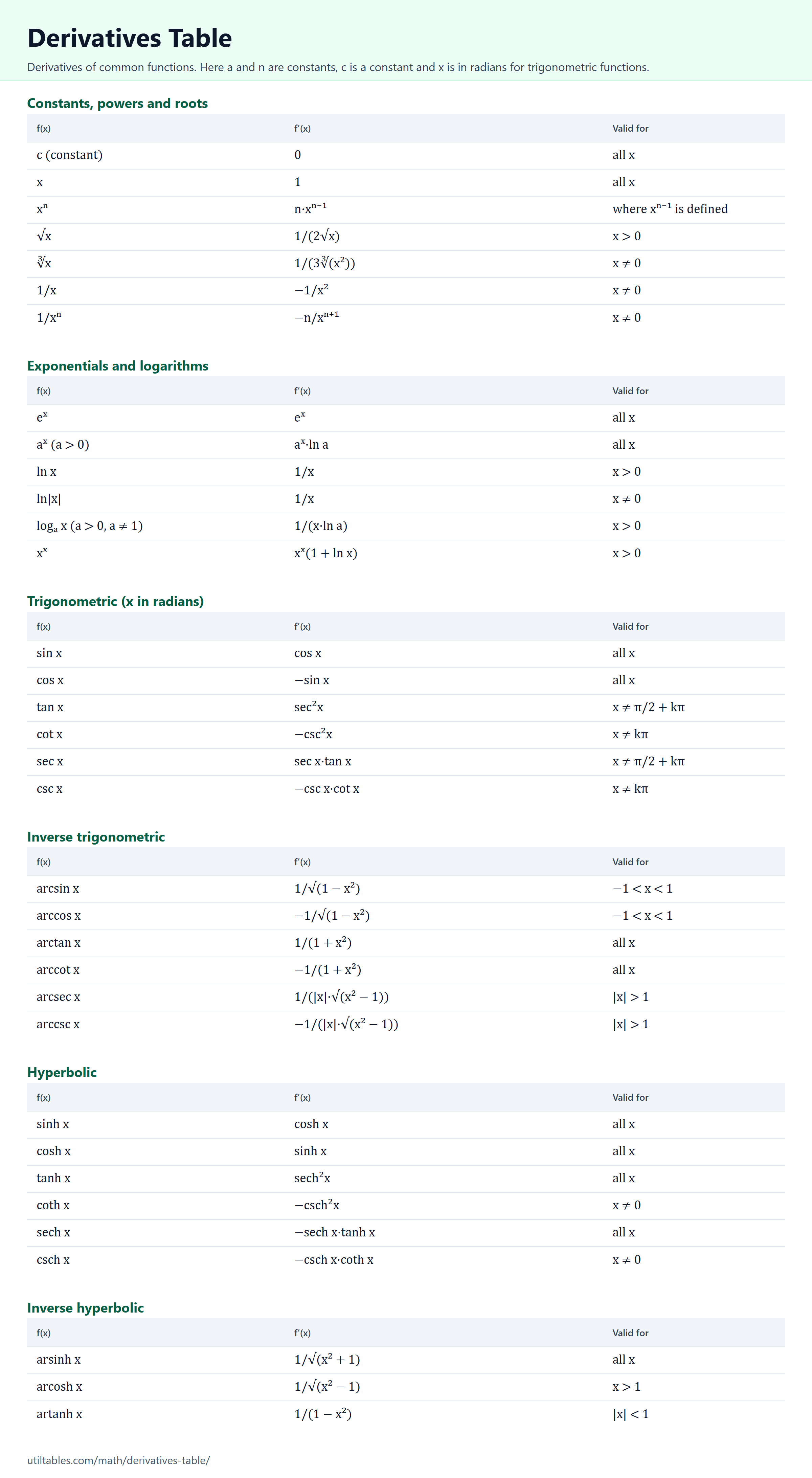
Derivatives Table as an Image and PDF
Save or print the table. Download the PDF (it also includes the differentiation rules).
Frequently Asked Questions
What is the derivative of eˣ?
It is eˣ itself. Up to a constant multiple, eˣ is the only function that equals its own derivative.
Why do the trigonometric derivatives assume radians?
The formula (sin x)′ = cos x holds only when x is measured in radians. If x is in degrees, an extra factor of π/180 appears, so (sin x°)′ = (π/180)·cos x°.
What is the difference between arcsin x and 1/sin x?
arcsin x is the inverse function: the angle whose sine is x. 1/sin x is csc x. Their derivatives differ: (arcsin x)′ = 1/√(1 − x²), while (csc x)′ = −csc x·cot x.
What is the derivative of a constant?
It is 0, because a constant does not change as x changes.